animation

Plate Gouging Timelapse

Please be patient while these gifs load.

I’ll talk a little to keep you awake in the meantime. Joint Pain isn’t over – I just had to interrupt it to show everyone where I am on violin #2. Rib assembly is all done, plates have been cut out, cleaned up, and edge thicknessed. Now I am gouging to make that poofy roundy violin belly shape. I took several photos along the way and packaged them up into little timelapse animations:


violin maple plate gouging, rough arching of the lower boutA roughed out maple butt cheek lower bout.


violin maple plate gouging, rough arching of upper and c bout, with tommy selfie

Roughing out an upper and C bout. Tommy makes a cameo! haha. That’s what happens when you sneak a selfie into my timelapse!!!!


violin maple plate gouging, scan of roughed arch

I like to use my ruler this way to judge what I have done. It’s a good way to read the arch.

Bass bar + architectural rendering tutorial

Back to school! Thankfully, I found my bass bar more or less the way I left it nearly a month ago. It’s all done and glued in now. Definitely not perfect, but a decent first attempt, I think.

fitting a violin bass bar with tension

This little animation explains the ridiculous challenge of the bass bar. You aren’t fitting it to just plop down and sit perfectly (though some people do?), you have to put it under a little tension. This means gradually over-cutting or lifting the ends of the bass bar, but still making sure the entire bar will make contact if you are pressing it into the plate. But you have to make sure that the way the bar contacts doesn’t twist your plate either! Just a few things to worry about. There’s probably only like a million other things too.

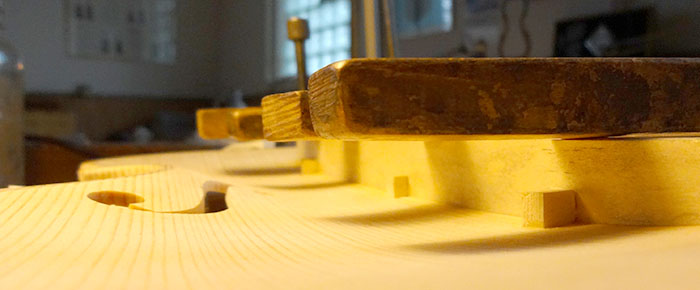
I glued up the bar yesterday and snapped some photos.

bass bar rendering tutorial - take a picture like it's a perspective

Those clamps. That bar. Those little cleats. The straight grain accentuating the topography of the spruce. All this inevitably leads me into….

Architecture RE:lapse

Did you know that I was once a great master of Photoshopping horribly underdeveloped models into magical architectural wonderlands? I exaggerate only as much as an architectural rendering does. People ask me how I do it. The methodology is very very simple, but making a good rendering requires some pretty well-developed eye judgment. Kind of like violins… That said, let’s take the above photo and make a rather ridiculous rendering lacking in good judgment.

1. Get you a nice sky

bass bar rendering tutorial - add sky

2. Add some green stuff

bass bar rendering tutorial - add green stuff

3. Busy things up with scalies and texture

bass bar rendering tutorial - add people and some random lines to make it more building-y

4. Fluff it up with some filters and highlights

bass bar rendering tutorial - fluff it up with some filters and fix it with shading!!!

Other notes: I am a heavy user of Multiply, masks, brush and pattern presets, and Flickr. I am a very light user of layers. Keep that file light.

And remember, if anything’s looking off or ugly, or if something’s underdeveloped, or if you’re too lazy to solve some particular detail, you can always just FIX IT WITH SHADING!

Operation help-Max-get-chickens, part 2

The $100 tractor for three chickens

Today we discuss the making of the chicken tractor, without the drama.

chicken tractor overview, with scalies

Bill of Materials

The following chart is what it would cost, not what we paid. We spent a bit more (sorry, Max), because we bought extra of a few things (mainly OSB, due to errors and then design changes). Though we also made use of scrap or leftovers from previous projects.

 
material unit cost quantity subtotal
Pressure-treated 2×4, 12′ $5.57 3 $16.71
2×3, 8′ $1.92 5 $9.60
OSB 7/16″, 4′ x 8′ $8.45 1 $8.45
Corrugated Metal Roof Panel, 26″ x 8′ $19.49 1 $19.49
1″ Teks Roofing Screws with neoprene washers (box of 120) $9.88 1 $9.88
2.5″ Exterior Wood Screw (1 lb box) $6.71 1 $6.71
1″ Exterior Wood Screw (1 lb box) $6.71 1 $6.71
1/2″ Hardware Cloth, 3′ ~$2.00 / lf ~11 ft ~$22.00
3″ Strap Hinges (pack of 2) $3.27 1 $3.27
TOTAL     $102.82

(Nerd note: I’ve always wanted to use an html table in an appropriate context!!! ie not for formatting my angelfire/geocities pages 10 years ago!)

Other stuff we used that may or may not cost ya:

  • Drill, circular saw, mitre saw
  • Staple gun for mounting hardware cloth
  • Metal-cutting blade for circular saw
  • Egg drawer!
  • Nice big branches for roost sticks
  • It’s a good idea to prime or paint the wood with something, especially the OSB, and especially especially where ever the OSB was cut.

Some Assembly Required

Chicken tractor construction, animated in gifs.

1. Partial A Frame

1 chicken tractor a frame construction
Floor size: 3′ x 6′
Height: ~3′
For 3 chickens, this is a bit on the small side.
The run area is 3′ x 4′.

2. Chicken House Frame-up

2 chicken tractor house frame-up
That OSB wall and its little mini-studs were assembled before sliding into place on the A frame.

3. Perimeter Cladding

3 chicken tractor perimeter close-off
Tediously cut your hardware cloth with wire cutters. Careful! It’ll draw bloood. Staple directly onto the frame.
Roost access door is strap hinged.

4. Corrugated Metal Roof

4 chicken tractor corrugated metal roof installation
This was our first experience with sawing through metal and using those Teks screws with built-in squishy stuff to prevent leaking through the roof.

5. Egg Drawer
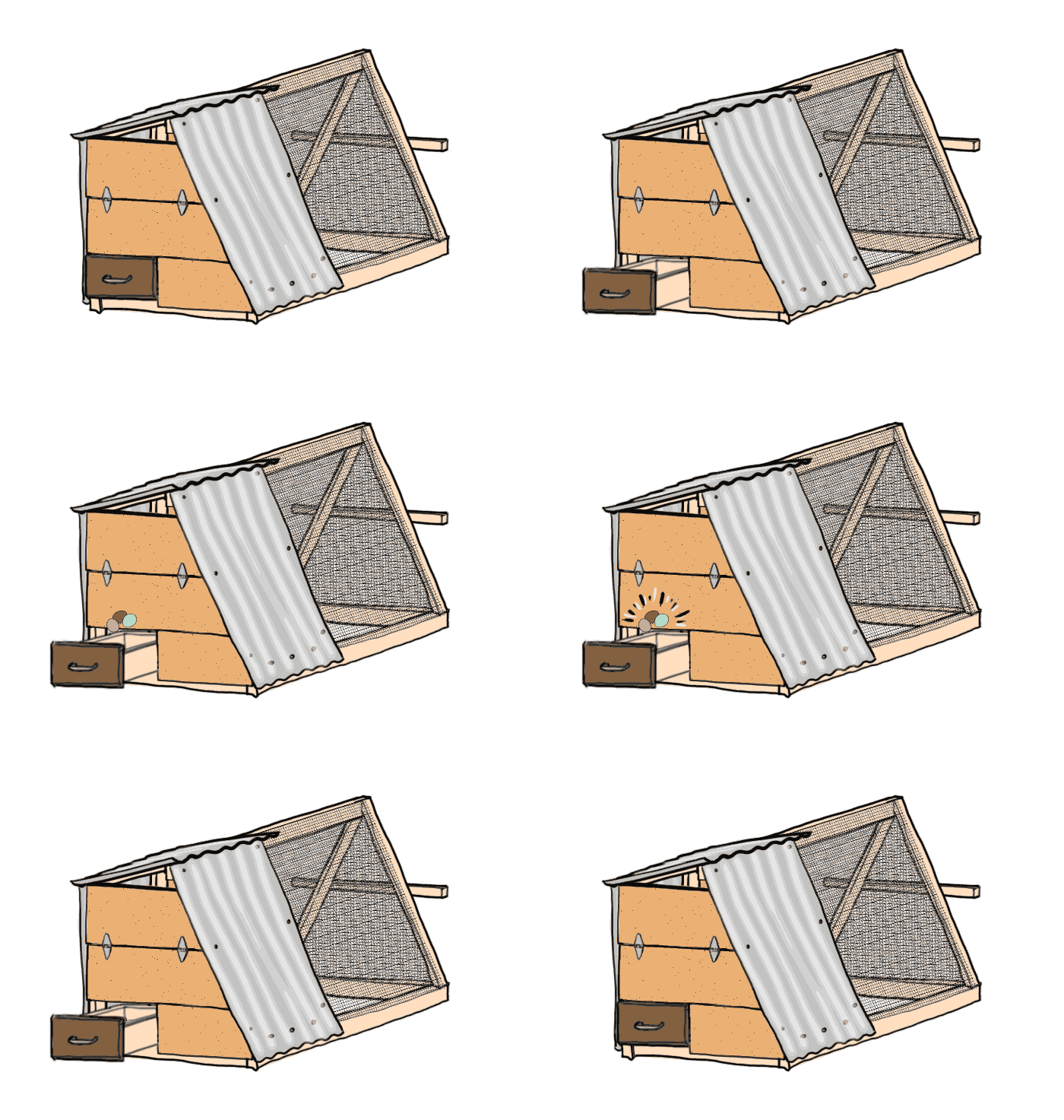
chicken tractor egg drawer
We ripped this drawer from my sister’s old kitchen counters. The box itself is about 11″ x 18″.

6. Insert Chickens
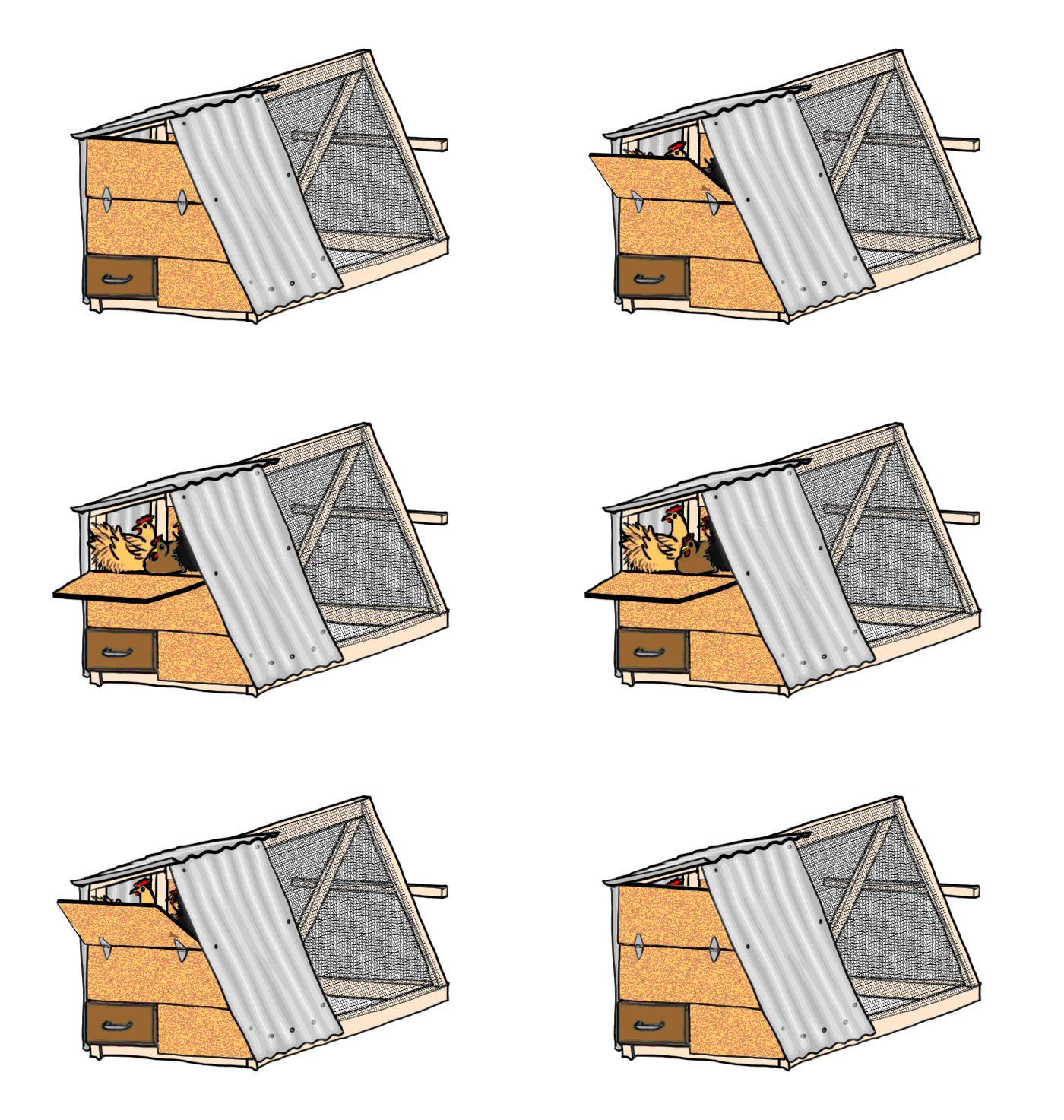
chicken tractor just add chicken
The coop is a bit tight, but miraculously, even the puffball Buff Orpington can fit down the 8″ ramp, and through the tiny door (which is maybe an 10″ high triangle.)

More Photos
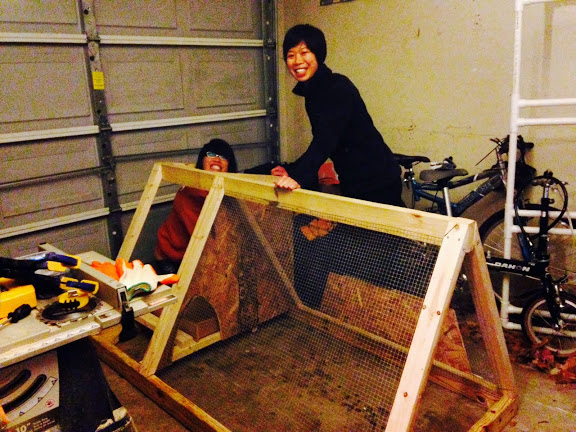
chicken tractor construction

In case you forgot, it rained, so we took the job inside.

chicken tractor construction i can't fit through the door

Peek-a-boo. See? The tiny door prevents human-sized predators from crawling in and attacking them in their chicken house at night.
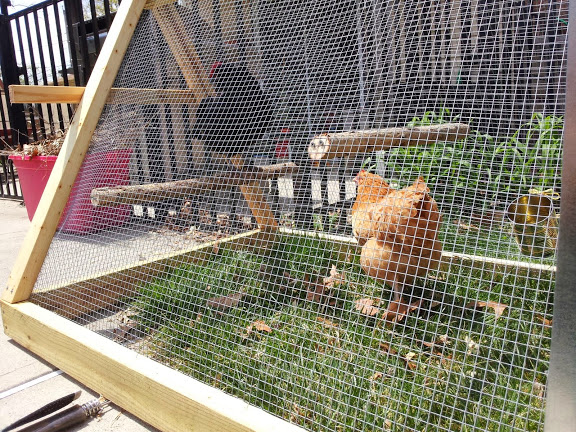
chicken tractor outdoor roosts

Ameraucana and Buff Orpington hanging out, and a shy Rhode Island Red hiding inside.
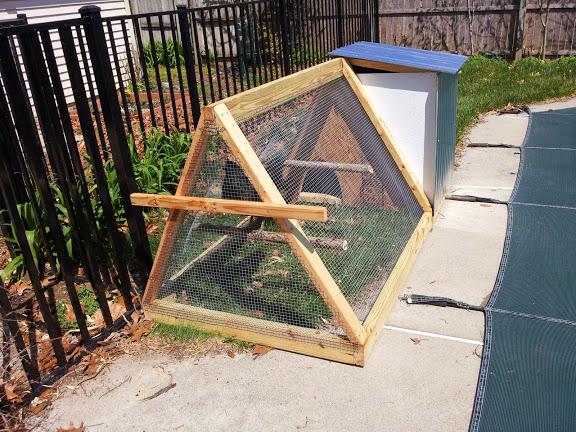
chicken tractor overview

Ta-da! All nice and… half-primed.

I’m still on session break from violin-making school, so violin-related posts will resume next week. Can’t wait to see my möbius strip bass bar!

In the meantime, next post will STILL be about chickens — troubleshooting and accessories.

Wedding Gift for Nora & Kevin

tea tray wedding gift for nora and kevin

My dear friend got married and I presented the couple an offering of tray-shaped wood. The tray is Bocote (which smells exactly like pickles when planed), the trim and legs are Goncalo Alves, and the inlaid letters are strips of walnut. Here’s what I learned from this project.

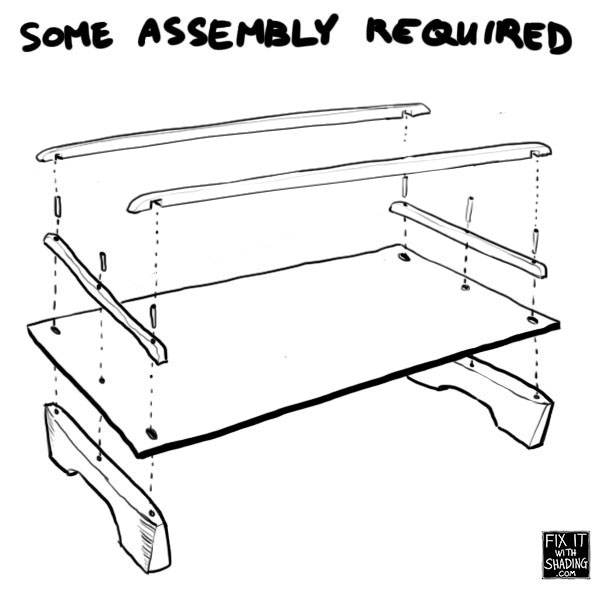
tea tray assembly axo

I made this up as I went, changing the plan five times a day. This is usually not recommended, but in the end, the schematics happened to work out beautifully. I have recently been obsessing over how to fasten tabletops to table aprons and how to handle joinery between boards with different grain orientation. The issue:

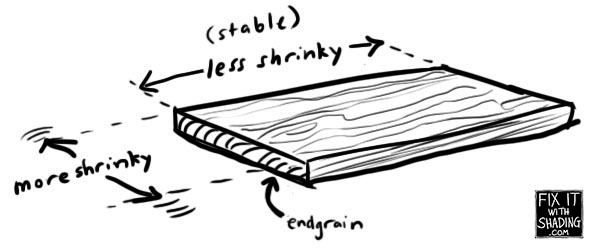
wood shrinkage and expansion across grain is greater than with grain

Wood happily expands and contracts (shut up, Omobono) with humidity and temperature. But it doesn’t shrink uniformly across all three dimensions. The biggest dimensional variation is ACROSS the rings of the tree, and the most stable dimension is along the length of the wood grain. The tea tray by nature is already subject to temp & moisture fluctuations – it might get washed, hot liquids might spill on it, it might live in Houston…. we must not let poor choice of joinery be another reason for warp:

expansion and contraction on wooden boards

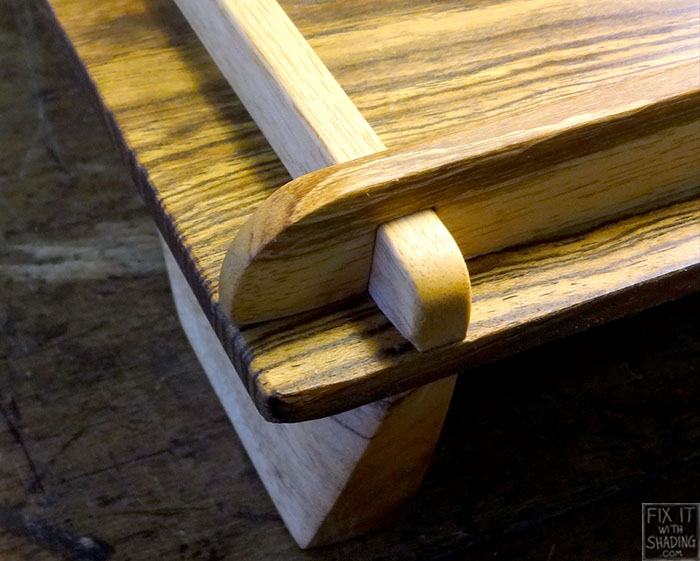
Note: the downside of slot & pin is the ends of the crossing piece may not stay flush to the edge of the board. In the case of this tea tray, it is not functionally crucial that they stay flush. A cupped tray would be far worse. So basically, the board is sandwiched but can move freely between the differently-oriented legs and trim, and that trim piece is further held down in this sort of lap joint thing:

tea tray wedding gift joint detail

So, hopefully this will make sense now:

tea tray assembly axo - glue joints tea tray assembly axo - do not glue zones

More tray stuff to come on Wednesday!

Please feel free to comment if you’d like to elaborate on this wood expansion/contraction topic, pick on the design of this tray, commission something from me (yes! come on, pleeease 🙂 ?), or whatever!

Planing lesson

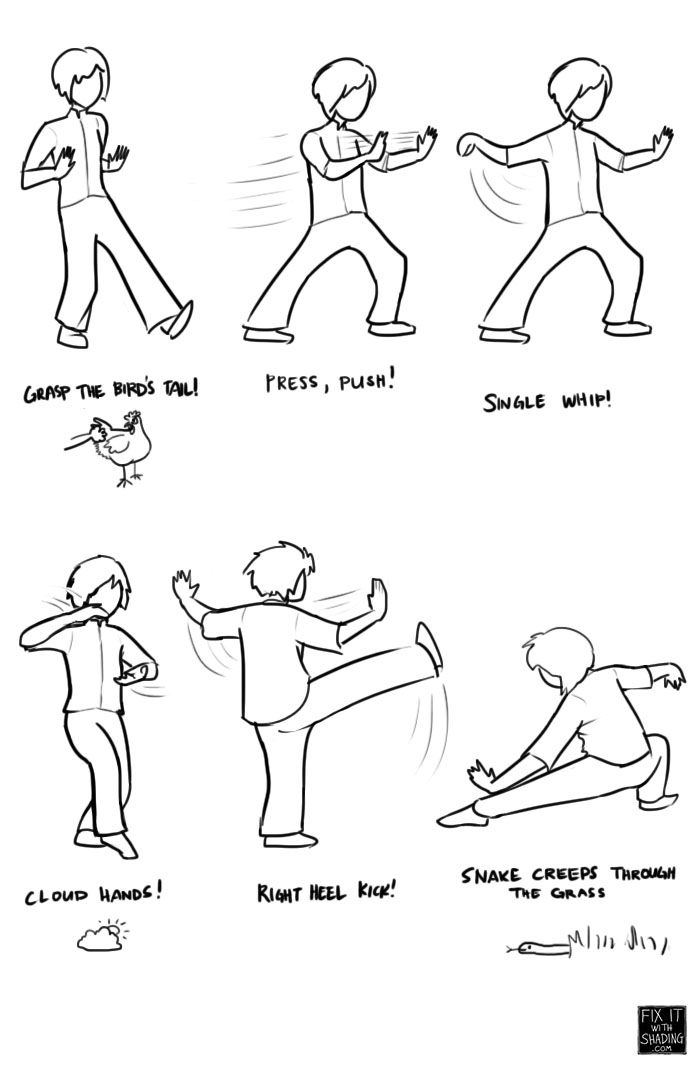
I shall open with some Plain ol’ Taichi moves:
plain ol' taichi steps

BUT WAIT! That looks familiar!
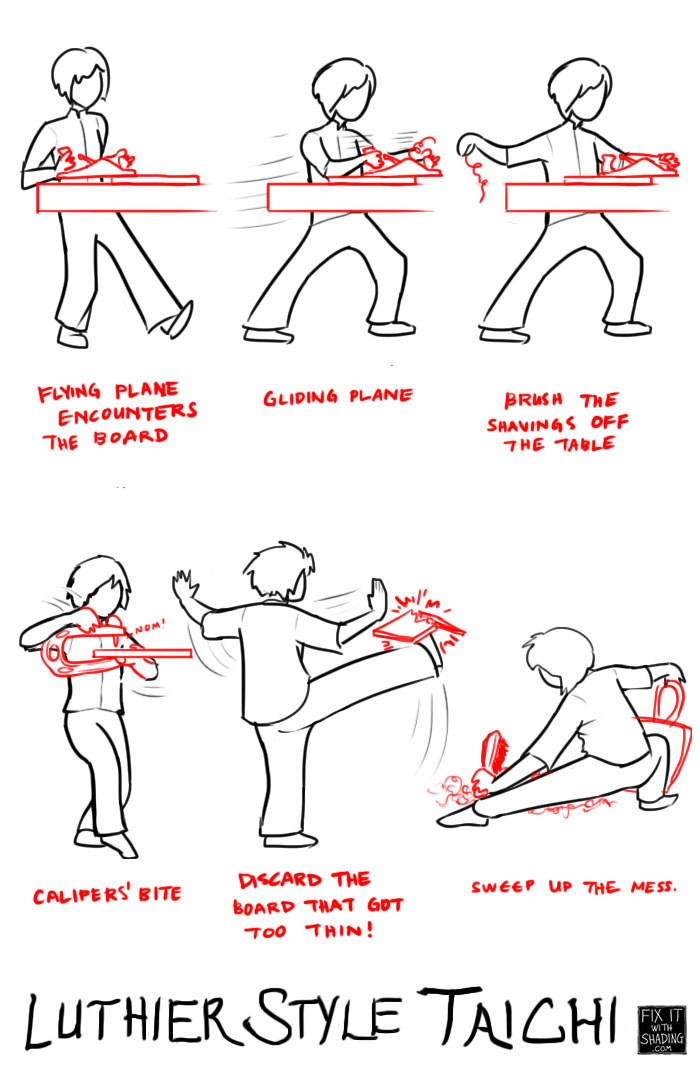
Compare with Plane ol’ Taichi moves:

plane ol' taichi steps, luthier style

When you plane, you’ve got to MOVE YO’ BODY!!! … and not forget to breathe and concentrate and stuff, etc etc.

But really, planing taichi-style puts the strength of your legs and the weight of your torso behind the plane, which will slow down arm fatigue and let your arms focus on controlling the plane. So, today’s lesson in review:

shaolin planing vs. cabbage patch planing

You don’t even need the check mark and X to tell you which is the right way – obviously you’d choose Shaolin Planing because it makes you look way cooler. But make sure you’ve got good footing, or else:

kung fu planing gone wrong